Takeaways from the Field: Learning from Chicago’s New-Generation Housing Cooperatives
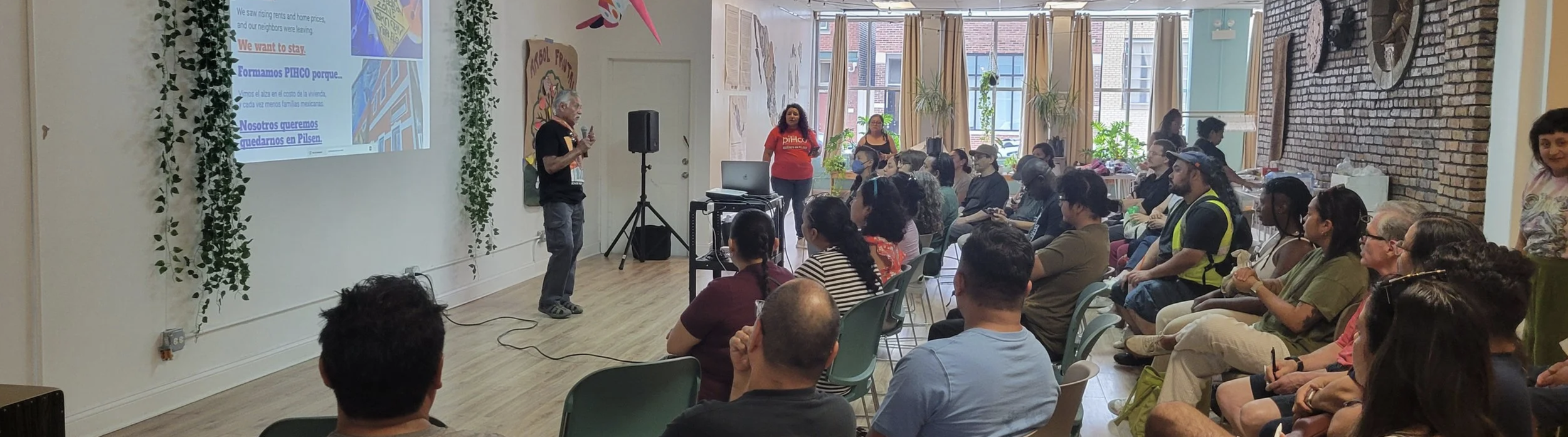
Chicago residents in a community meeting discuss the formation of Pilsen Housing Cooperative
The following post is compiled from research conducted by the University of Miami’s Community Ownership Learning and Action (COLA) Lab throughout 2024 and 2025, which will be formally published through a case study series titled Community Ownership Field Guide: A Multi-City Panorama. It complements our field note, “Holding the Line: Inside Chicago’s Trailblazing Housing Cooperatives,” which visually summarizes our research, and an April 2 webinar titled “From Public Experiments to Field Formation: Lessons from Chicago’s Housing Co-ops.”
Chicago’s housing crisis is usually described as a problem of affordability or supply. But that framing masks a more fundamental issue.
Over the last century, housing in Chicago turned into a financial asset rather than a stable place to live. (1) That shift rests on a long history of racialized exclusion and extraction. Black Chicagoans were confined through restrictive covenants, excluded from conventional mortgages, and targeted through contract buying. Latinx communities were displaced by urban renewal, highway construction, and university expansion.
Since the 1970s, these foundations have been bolstered by a growth model that hinges on real‑estate development — through higher property values, zoning changes, tax increment financing, and public‑private development. (2) Today, more than half of renters are cost-burdened, and in many neighborhoods, small multifamily buildings — historically a backbone of affordability — have been steadily absorbed by investors. The result is not just high housing costs, but a market that systematically produces instability. (3)
Chicago’s new generation of housing cooperatives has emerged in direct response to this landscape. While many earlier cooperatives were born out of federal programs (e.g., HUD Section 213), today’s new‑generation co‑ops work the market, nonprofit assistance, and local government instead. They also differ by pursuing explicitly political goals — permanence, long-term affordability, and local control in an increasingly hostile housing market.
In a cooperative, residents buy shares in a building they own together, rather than purchasing individual units. Those shares come with the right to live in the building and participate in collective decision-making. Resale formulas limit how much profit someone can make when they sell their home, preserving affordability for future residents. Instead of chasing maximum asset appreciation, co-ops prioritize collective stability and shared stewardship.
The three cooperatives at the center of this study — Logan Square Cooperative (LSC), Pilsen Housing Cooperative (PiHCO), and La Villita Housing Coop — sit in different neighborhoods at different stages of gentrification, displacement, and upheaval. Logan Square shows what happens once gentrification has already transformed a neighborhood demographically and economically. Once a neighborhood where Latinx residents comprised over half the population, that number has dropped to just about one-third. (4) Pilsen reflects an area under intense real estate pressure, where investor activity is especially strong – 26.1% of all residential sales in 2024 – and the Latinx population has declined by 20% while incomes have been stagnant since 2000. (5) Little Village sits at a threshold point: housing stress is already severe – 53% of renters are cost-burdened – and investor activity is rising. (6)
The Community Ownership Learning and Action Lab, a collaborative of national organizations based at the University of Miami, conducted 67 in-depth interviews and site visits across three cities to answer a simple but important question:
How do projects like these survive, and even grow, in such a precarious landscape? For Chicago’s housing co-ops, the answer is that they redesign ownership, stitch together financing, translate across institutional worlds, and carry much of the field-building work themselves.
Rethinking Cooperative Ownership
Logan Square Cooperative (LSC) was founded in 2003 by residents who wanted an alternative to traditional homeownership. They visited more than 25 buildings for over a year to secure a property. The group “literally begged” a community lender to approve the loan days before closing and had to bring in a second lender to make the deal work.
Two decades later, LSC has built a cooperative way of life: shared common spaces, merged utility practices, and internal reserves, culminating in a deeply relational model of living.
LSC does not aspire to grow, at least not yet, but rather is prioritizing stability and self-determination over scale. However, it has become an informal mentor for other co-ops — a “unicorn” in Chicago’s grassroots housing landscape — offering tours, documents, and advice to nascent groups.
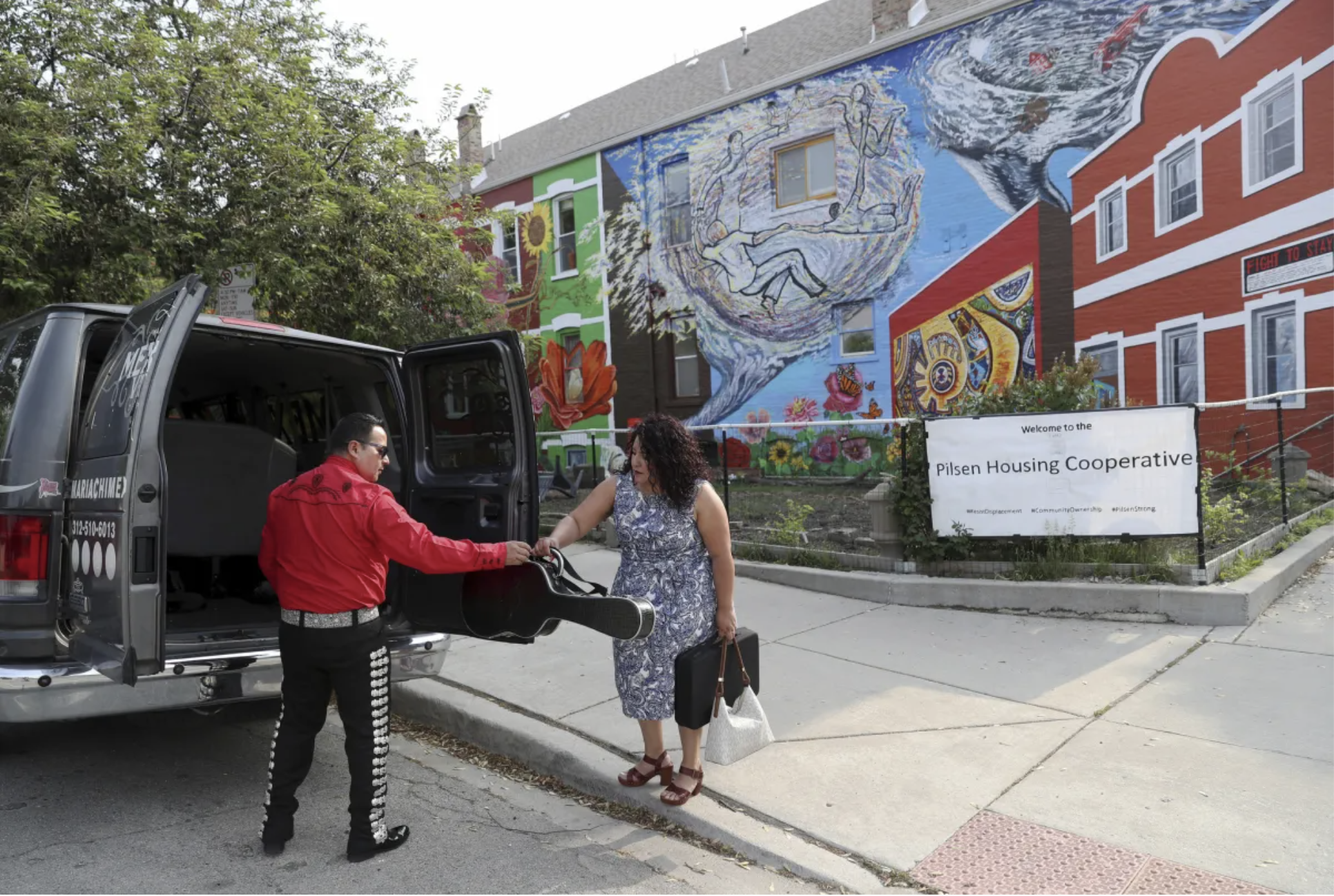
Residents in front of Pilsen Housing Cooperative in Chicago, IL
For Pilsen Housing Cooperative (PiHCO), on the other hand, scale is essential to preventing displacement. As one founder put it:
“If you make just one of these, you’re never going to have any impact.”
In 2016, PiHCO emerged in a neighborhood with a long history of Mexican-American organizing and a growing sense that investor ownership was reshaping the community. “Half the properties [on my block] are now LLC owned,” one founder noted. The cooperative solution was not to save a single building, but to “lock down as much property as possible for community as affordable cooperative ownership.”
PiHCO created a scattered‑site model that lets it pool resources, grow capacity, and gradually expand its footprint. A single cooperative governs several properties through a mixed board of resident and non‑resident members. To keep the organization from “drifting” once it starts seeking public subsidies and institutional financing, the co‑op built in high participation thresholds (e.g., a 75% quorum for major decisions) and site‑specific governance layers.
By the fourth acquisition PiHCO added “generator buildings” that function as internal lenders. Those buildings generate $30‑35 k a year for reserves, with potential for significantly more.
The model avoids strict income caps. PiHCO initially targeted 80% AMI but now reaches 50 to 60% AMI affordability due to stable pricing over time. Tighter caps would have excluded critical early contributors.
La Villita Housing Coop (La Villita), founded in 2023, emerged from years of anti-displacement and eviction defense work in Little Village. For its founders, co-op development was a shift from reacting to crises toward building a more permanent solution:
“I got tired of just trying to deal with each individual who was getting evicted. I wanted to see if there was some kind of model that looked at root change, as opposed to just the Band-Aids.”
La Villita is building a stewardship model in which the founding board remains in place through the second acquisition and members are selected with an emphasis on neighborhood rootedness, participation, and collective responsibility. None of the three founders will live in the co-op. Volunteer stewards kickstart development and later bring in and train resident-owners.
The model is explicitly anti-displacement, yet that commitment brings its own tensions. After consulting with technical assistance providers like New York City’s Urban Homesteading Assistance Board (UHAB), La Villita set the share price at $5,000 with a 3% annual compound return. “You still get equity,” one founder said, “but not $60,000 after 20 years — maybe $15,000.” This protects deep affordability but also raises hard questions about inclusion, expectations, and long-term financial sustainability.
Cobbling Together Financing
Financing is always a major barrier. Most lenders are unfamiliar with cooperative ownership, share loans (7) are rare, and underwriting standards favor conventional real estate financial products. As a result, co-ops must stitch together acquisition strategies using seller-financing, grants, public subsidy, mission-driven lenders, and, at times, personal risk.
LSC had to bring in a second lender — Shared Capital — days before closing because Chicago Community Loan Fund’s (CCLF) loan committee became skeptical of the deal.
PiHCO’s first acquisition relied on seller-financing from a neighborhood owner willing to accept almost nothing down, but who believed in the mission and remained as a co-op member. They were able to close a small gap with a loan from Shared Capital.
Their second deal layered personal financing, a loan from Self-Help Credit Union, and a surprise grant from the Builders Initiative. The City of Chicago, through its Shared Equity Investment Program, was a primary source for the third deal, alongside another Shared Capital loan.
La Villita’s first acquisition was catalyzed through grants from CCLF and the city, but a conditional loan from Shared Capital threatened the closing. A founder stepped in with a personal bridge loan when other financing sources were too expensive to maintain fidelity to their mission.
Translating Across Institutional Spheres
Co-ops also depend on a small number of trusted people who can move between very different worlds, such as community organizing, real estate finance, law, and public policy. These “superstars,” as one LSC member referred to them, or “co-op stewards” make co-op projects recognizable to lenders and funders while keeping them grounded in community priorities.
These stewards explain cooperative models to nonprofit partners and like-minded projects and adapt governance structures to fit financing requirements. They also forge and secure partnerships with lenders, funders, and city actors that new co-ops can rely on. They even advocate for resources and policy change at the local and state levels. Through state legislation, a PiHCO founder secured a 1% allocation in the Illinois Housing Development Authority budget specifically for housing co‑ops.
Co-op stewardship also works horizontally through peer mentorship. LSC informally helped PiHCO get started; PiHCO, in turn, became “pivotal” for La Villita. This is a kind of proto-infrastructure for the field. It is real but improvised, valuable but under-resourced and difficult to scale.
Connecting the Field Themselves
Co-ops are not entering an established ecosystem for their work. In more established sectors, intermediaries coordinate development, train newcomers, standardize practices, and hold networks together. In Chicago, much of that work is done by the co-ops themselves — sharing documents and helping others structure their models, advising new groups, connecting peers to lenders and public agencies, and creating informal learning networks.
As one founder put it, Chicago’s co-ops are “not competitive but supportive,” often serving as each other’s first line of technical assistance. This dual role — as individual projects and the field’s infrastructure — defines Chicago’s housing‑co‑op landscape and determines how its network is organized.
Through a social network analysis, we conducted a basic ‘stress test’ to show that when the co-ops are included, the field appears coordinated and connected. (8) Co-ops bridge between unlikely partners and create gateways to resources.
But when the co-ops are removed, the network becomes fragmented, thin, and siloed. It fragments from one cohesive network to twenty-two different components, including many unconnected nodes, and small clusters within the remaining network. Capable institutions exist, but their connections are thinner, indicating the cooperative field still lacks a steady backbone infrastructure. (9)
This indicates that Chicago’s field is still forming rather than fully stabilized. Its cohesiveness depends on the very projects it is meant to support.
The entire social network analysis will be published in a forthcoming comparative case study from COLA Lab, including in-depth appendices with deeper breakdowns.
Why This Matters for Practice
Co-ops are resourced and treated as projects, but they operate as organizations.
Because most intermediaries, TA providers, and philanthropic funders are accountable to conventional reporting, underwriting, and timelines, they can open doors to capital while simultaneously reinforcing a narrow, transactional definition of success. As a result, co-ops must either present themselves as “projects” that fit government‑ and lender‑friendly language and reporting templates; or improvise work‑arounds rooted in strong community relationships.
As one CCLF lender explained:
“We are project- and transaction-oriented, especially loan funds like CCLF. And so we engage with the space in a way where we’re trying to build a pipeline in an organizationally self-serving way. Organizing, policy, movement building — those aren’t our primary focuses.”
Because of this orientation, co‑ops are forced to translate their day‑to‑day reality into the limited metrics that funders use, or they risk disappearing from the funding pipeline altogether.
For example, a co‑op needs continuous property management, democratic governance, and member education. Those activities — the “unseen work” that follows acquisition — are rarely part of financial underwriting, even though they are the backbone of community ownership and essential for long‑term financial stability.
Understanding cooperatives are ongoing organizations — with sophisticated operations, long life-spans, and a need for recurring revenue — means we should learn from the tactics they use on the ground.
PiHCO’s “scattered‑site” model, anchored by a single parent entity and supported by “generator buildings,” stretches affordability, boosts sustainability, and builds capacity with every acquisition while keeping governance community‑driven. Their first purchase hinged on finding a sympathetic landlord willing to sell and finance the deal — a strategy that mirrors how traditional organizations secure assets. In the worker‑co‑op world we already see a “silver‑tsunami” pattern: aging landlords open to selling to community ownership buyers.
La Villita’s founder‑led stewardship of cooperative housing represents a meaningful modal shift. It blends the DNA of nonprofit programming and affordable‑housing development, yet it is the sort of replicable activity you would expect from a community‑based organization.
And lastly, individuals are subsidizing the field with unpaid labor, embodied in “superstar” stewards. PiHCO and LSC leaders brokered UHAB’s entry into Chicago using city funds. As a UHAB staffer noted,“They’re volunteers. This isn't their job and it’s not possible to scale [the housing co-op movement] that way.” Recognizing this labor points to the need for funded positions, such as the kinds of fellowships and grant-funded roles we see in other sectors, like community health worker models.
A deeper dive into these implications, with concrete recommendations to address them, will be published in the COLA Lab’s forthcoming series, Community Ownership Field Guide: A Multi-City Panorama.
Bottom Line
Community ownership is often portrayed as a simple alternative to the real estate market, but in practice it is far more complex. Co‑ops operate partly outside conventional real estate channels while gradually reshaping those channels through improvised, under‑resourced work. They are not marginal experiments; they are building real housing, preserving affordability, creating democratic governance, and weaving together a nascent ecosystem.
The broader lesson is that community ownership survives because people perform the hidden work that makes it recognizable, financeable, governable, and repeatable. In Chicago, new housing co‑ops are constructing the missing infrastructure of a different housing system — one stitched together through cooperation, experimentation, and collective labor in the cracks of a market that was never built for them.
For the full analysis and detailed recommendations, watch for COLA Lab’s forthcoming Community Ownership Field Guide: A Multi‑City Panorama, a comparative study of community‑ownership projects across U.S. cities.
1 : Harvey, David. 2005. A Brief History of Neoliberalism. Oxford: Oxford University Press.; Gotham, K.F. 2009. “Creating Liquidity out of Spatial Fixity.” International Journal of Urban and Regional Research 33(2): 355–371.
2 : Weber, R. (2002). “Extracting Value from the City: Neoliberalism and Urban Redevelopment.” Antipode, 34(3), 519-540; Hackworth, Jason. 2007. The Neoliberal City. Ithaca, NY: Cornell University Press.
3 : Institute for Housing Studies (IHS). (2023) Chicago Housing Market Indicators. DePaul University; City of Chicago (2023). “We Will Chicago.” City of Chicago. https://www.chicago.gov/content/dam/city/depts/dcd/we_will/we_will_documents/cpc/WWC_Final_CPC.pdf
4 : U.S. Census Bureau. 2000. Decennial Census, Summary File 3.; U.S. Census Bureau. 2018–2022. American Community Survey 5-Year Estimates, Table B19013; Institute for Housing Studies (IHS). (2023) Chicago Housing Market Indicators. DePaul University; Institute for Housing Studies (IHS). (2023) State of Rental Housing in Chicago. DePaul University.; Chicago Metropolitan Agency for Planning (CMAP). (2025). Logan Square: Community Data Snapshot. Chicago Metropolitan Agency for Planning, Chicago Community Area Series. https://www.cmap.illinois.gov/wp-content/uploads/dlm_uploads/Logan-Square.pdf; City of Chicago (2023). “We Will Chicago.” City of Chicago. https://www.chicago.gov/content/dam/city/depts/dcd/we_will/we_will_documents/cpc/WWC_Final_CPC.pdf
5 : Id
6 : Id
7 : For more on share loans, visit this resource.
8 : Our analysis is substantiated by key metrics indicating connectivity, strength of connections, network density, and centrality to said connections, as well as analysis that filters out little-connected elements. Our full network analysis will be published as part of our multi-city case study series.
9 : We predict this will change with the emergence of intermediary organizations designed to help connect cooperatives to organizations and institutions that can resource and assist them. In sum, the ecosystem is growing around this work. Most notably, The Community WEB, which launched in 2025, carries the explicit aim of becoming a backbone for community ownership work across Chicago, providing convening capabilities, shared services programming, connections to expert technicians, and advocacy muscle.